
McLaren McL 6GT Revealed with Manual Gearbox and M6GT-Inspired Design
McLaren has unveiled the McL 6GT at the 2026 Monterey Car Week, presenting a modern interpretation of Bruce McLaren’s original M6GT supercar vision.
The concept connects McLaren’s early road-car ambitions with the company’s modern engineering philosophy. It also previews a new type of highly exclusive McLaren supercar positioned beyond the brand’s core portfolio, with a production version planned for 2028.
One of the biggest highlights is the return of an authentic manual transmission. The McL 6GT becomes the first McLaren since the legendary McLaren F1, introduced in 1992, to feature a manual gearbox.

Inspired by Bruce McLaren’s M6GT
The McL 6GT takes its inspiration from the M6GT, a project originally envisioned by Bruce McLaren as McLaren’s first road-going supercar.
While the original M6GT never reached full production, the new concept reinterprets its philosophy using modern materials, technology and engineering.
McLaren says the concept represents a more tactile and driver-focused direction, combining its heritage with a future-facing approach to performance cars.
A Return to Analogue Driving
The McL 6GT focuses heavily on mechanical interaction between the driver and the car.
The manual gearbox, hydraulic steering and tactile controls are intended to create a more direct driving experience, with every gear change, steering input and throttle movement designed to feel deliberate.
The cabin also uses machined aluminium controls with knurled surfaces, adding a mechanical character to the interior.
The gear lever is particularly distinctive, featuring a three-dimensional Speedy Kiwi detail inspired by McLaren’s early visual identity. The design of the lever has also been developed around the feel and movement of each gear change.
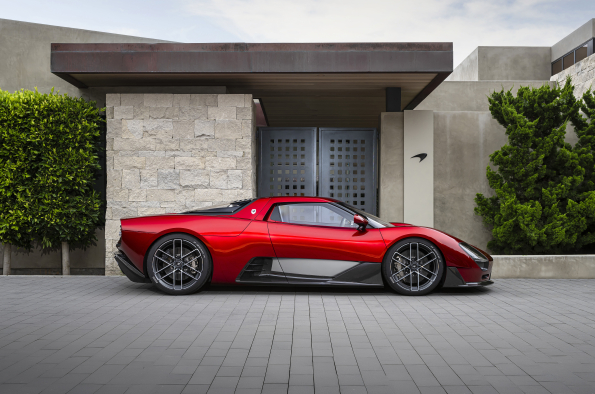
Design Inspired by McLaren’s Racing Heritage
The McL 6GT takes design cues from the racing prototypes of the 1960s while translating their proportions into a modern supercar.
The car sits extremely low and wide, with a low nose and a flowing body that references the M6A Can-Am racer, which formed the basis for the original M6GT.
Its bodywork features clean surfaces and uninterrupted volumes, flowing towards a distinctive Kammback-style rear.
The roof transitions directly into the rear deck and engine cover, giving the car the appearance of a single continuous form. The cabin is visually integrated into the bodywork rather than appearing as a separate structure.
Heritage Details
Several elements of the original M6GT have been reinterpreted throughout the McL 6GT.
The distinctive Racing Loop design takes inspiration from the original car’s rear lights and has been integrated into the aerodynamic architecture.
Bruce McLaren’s original M6GT number plate has also been recreated as a subtle tone-on-tone graphic, while his signature appears in the engine bay.
The Speedy Kiwi is discreetly incorporated into the fuel filler cap, providing another connection to McLaren’s early history.
Inside, traditional boxed quilting has been given a contemporary interpretation, while the digital instrument display combines modern technology with a clear and uncluttered presentation.

Carbon Fibre at Its Core
Lightweight construction remains central to McLaren’s philosophy, and the McL 6GT takes this approach into a new era.
The concept uses a full carbon-fibre monocoque combined with carbon-fibre bodywork. This construction helps reduce weight while providing the structural foundation for the car’s performance-focused character.
Exposed gloss carbon fibre is also used inside the cabin, creating a visual connection to McLaren’s motorsport heritage and reinforcing the lightweight philosophy.
V8 Power and Rear-Wheel Drive
The McL 6GT combines its lightweight carbon-fibre architecture with a V8 internal-combustion engine and rear-wheel drive.
Rather than focusing solely on outright performance figures, McLaren has designed the concept around the relationship between the driver, powertrain and chassis.
The manual transmission further strengthens this approach, giving the driver direct control over the car’s power delivery.
From Concept to Production
The McL 6GT is more than a styling exercise. McLaren says the concept establishes the foundation for a new, highly exclusive type of supercar that will sit beyond its core and expanded model portfolio.
A production version is planned for 2028, giving McLaren the opportunity to create a road car that combines the company’s modern carbon-fibre expertise with the analogue character and heritage-inspired design of the McL 6GT.
The concept therefore represents both a tribute to Bruce McLaren’s unfinished M6GT dream and a preview of a new direction for the brand.